Introduction
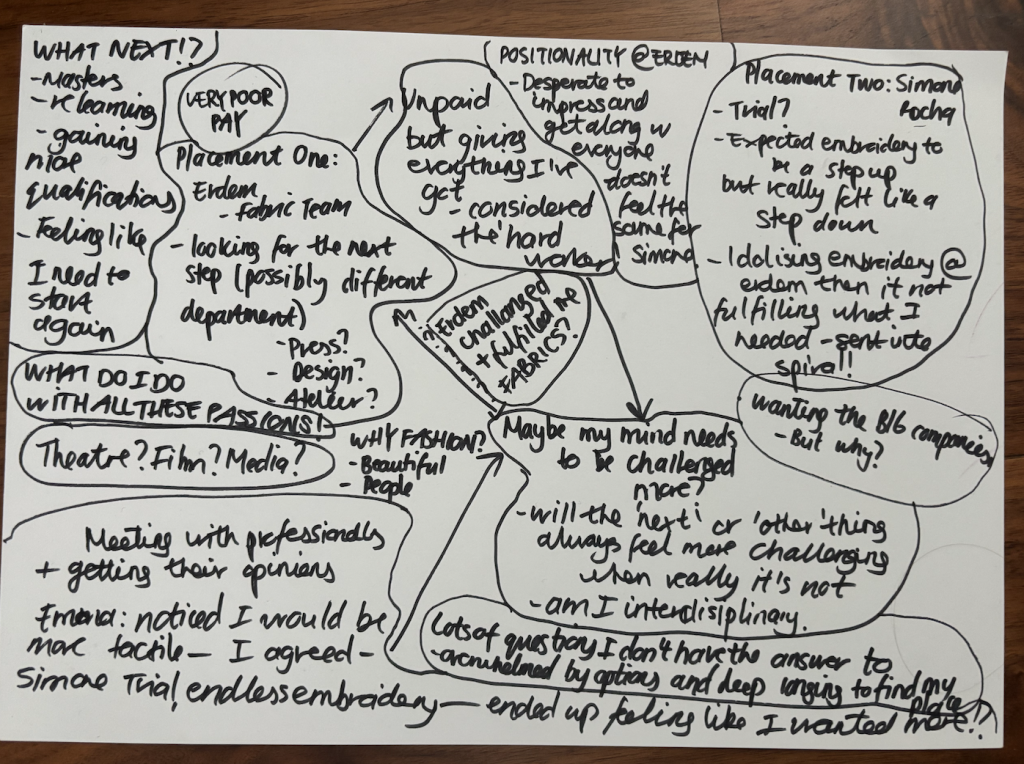
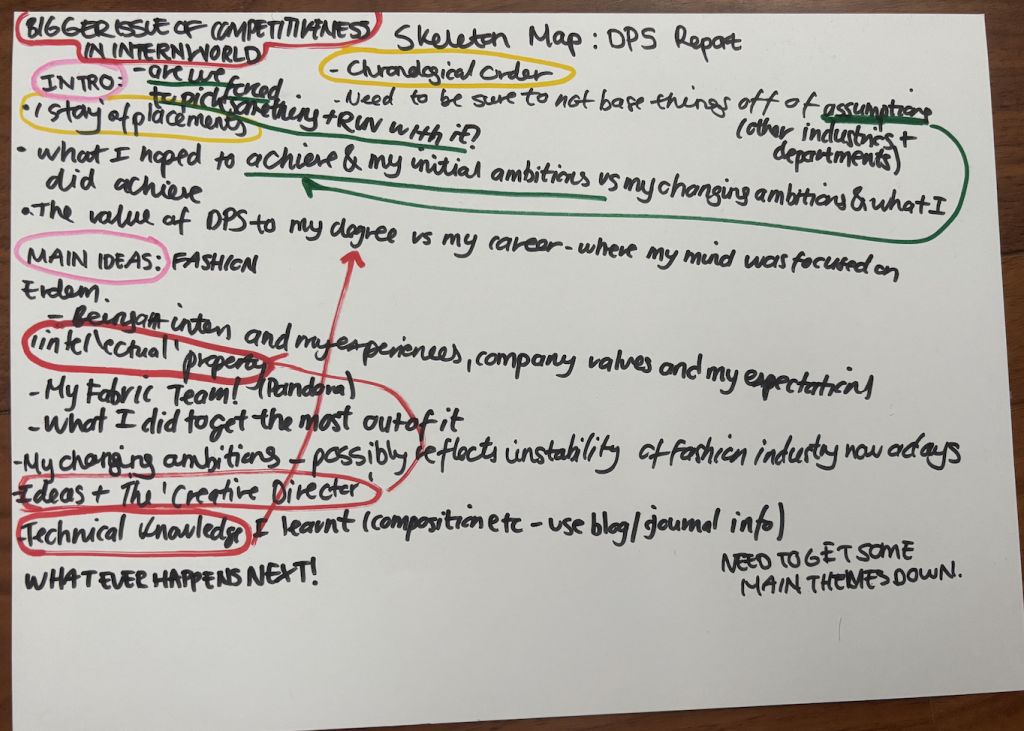
When deciding on whether to do a placement year and how it would benefit me, I can now reflect that what I initially wanted was, unsurprisingly, different to what I received. I started off by applying to huge luxury brands in highly competitive roles which I was encouraged to do by one of my dad’s new friends that he seemed to make everywhere he went. At this point I wanted a paid, fast paced corporate role, in the beauty/fashion industry, where I could spend the next 12 months discovering what I might want in the future. However, when speaking with tutors I was told not to commit to one company for the whole year. Luckily, I just missed out on a role at Dior Beauty for their Retail and VM placement. One big take away from this year has been knowing where to put my eggs, this is something I struggled with being at 3 different places, so on reflection I am grateful that role did not work out and so wasn’t tied to one place throughout my experience. This lesson alludes to how my agility and resilience has been in my favour throughout this year and is possibly something I should embrace more as I navigate my many passions and ambitions for my career. These attributes alongside my curiosity and love for the creative world, and its many facets, allowed me to be critical and reflective on the companies I have worked for, the roles I have done and the skills I have developed which now leaves me feeling more equipped to tackle future career endeavours. When I reflect on how these above points intersect with my positionality, I begin to understand why I have extracted certain things from my experience and how I wish to use them to develop my personal creative practise. Being an intern for a total of 13 months has given me a space to lean into learning new skills. Starting at the ‘bottom of the barrel’ means I could start from square one and reset. I don’t believe this is a circumstance seen in other places as there is always someone who has an expectation of you, for example part time employers, tutors and teachers, family and friends. This added pressure for me personally doesn’t always allow for learning and growth in my practise, so I am very grateful for the time dedicated to this and I know this will benefit my craft and practise.
Chapter 1: First placement at ERDEM
- intro to the role and company structures
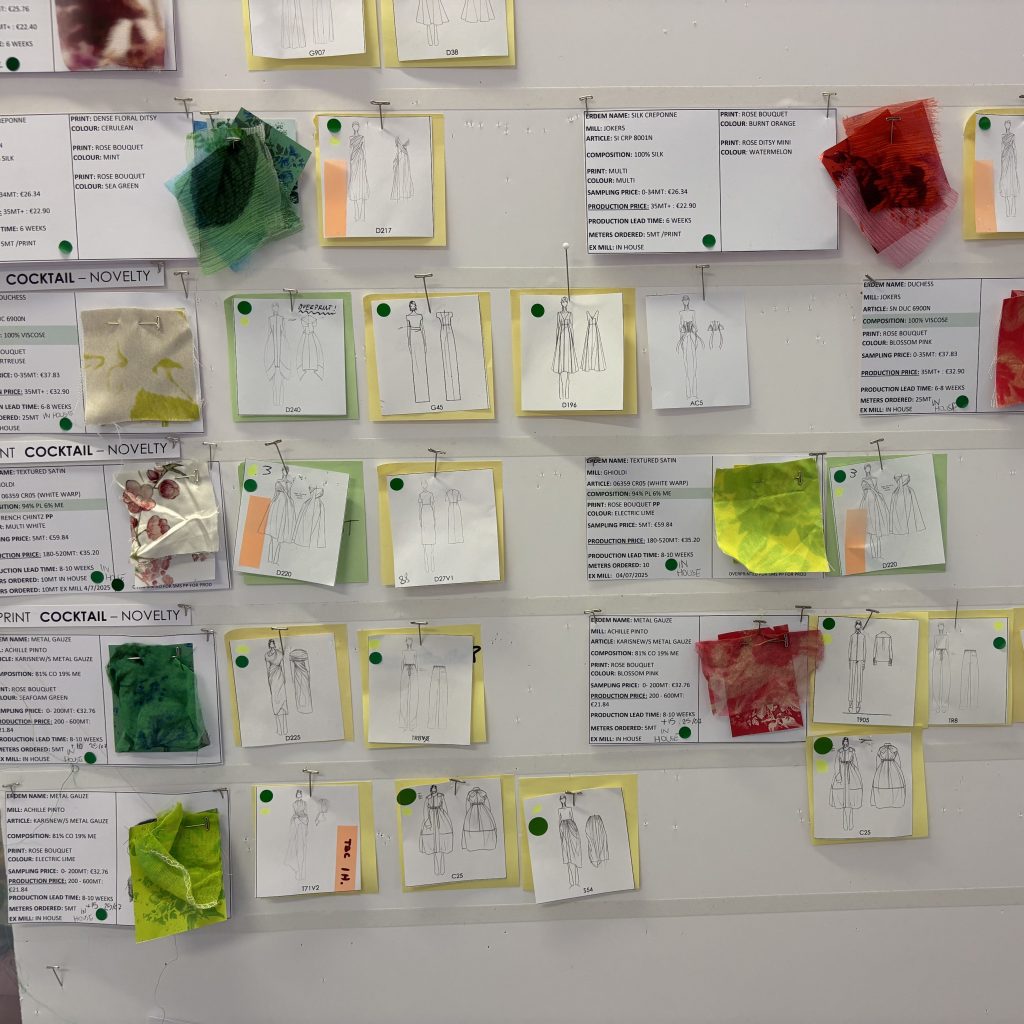
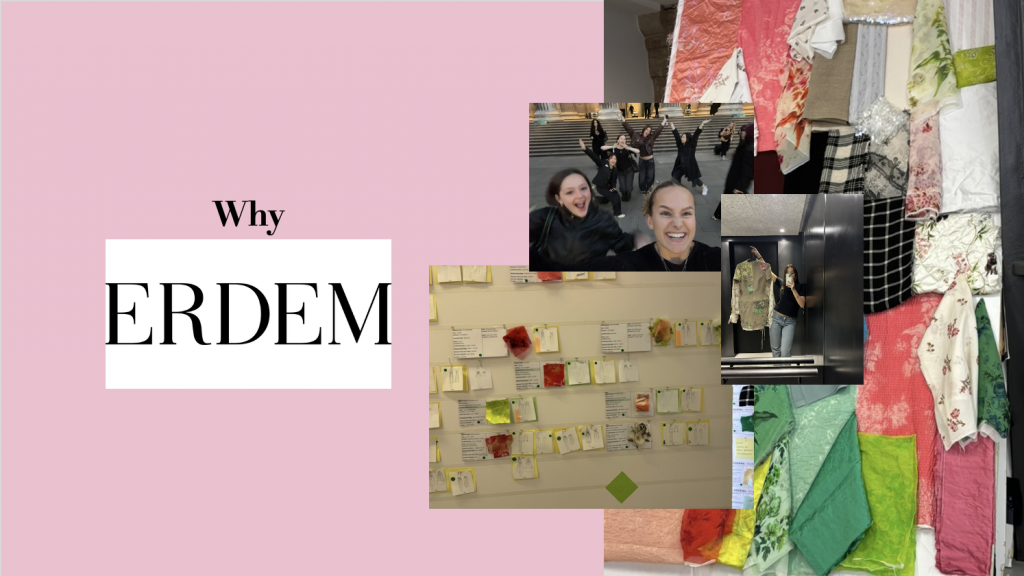
The first interview I did was for a Fabric and Trim Development Intern at ERDEM, it was the most nervous I had felt in a long time. I hadn’t presented my work in around 2 years and did not know what the standard would be. The thoughts going through my head where that I wasn’t good enough or established enough to work somewhere like this. On reflection, I realise now that I let my emotions get in the way. Although the adrenalin from this helped me answer situational questions that I was not expecting, I wish I went into the interview with more clarity. This could have been achieved by thorough research into the brand and role, so I knew what to expect. In the end I got the role which gave me a huge boost of confidence.
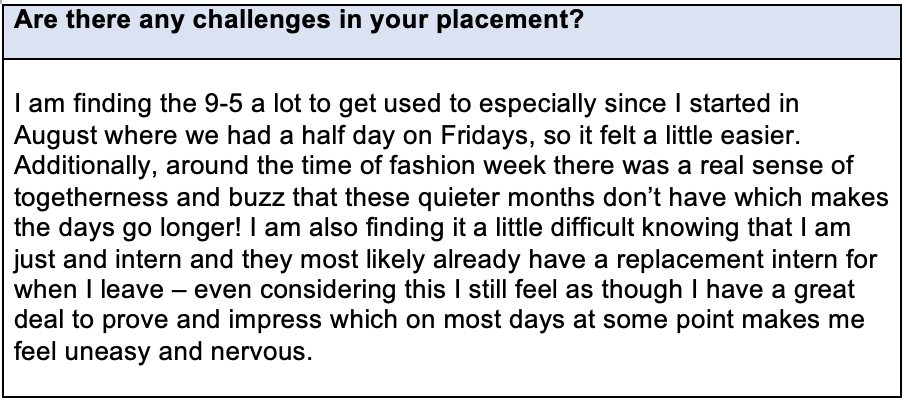
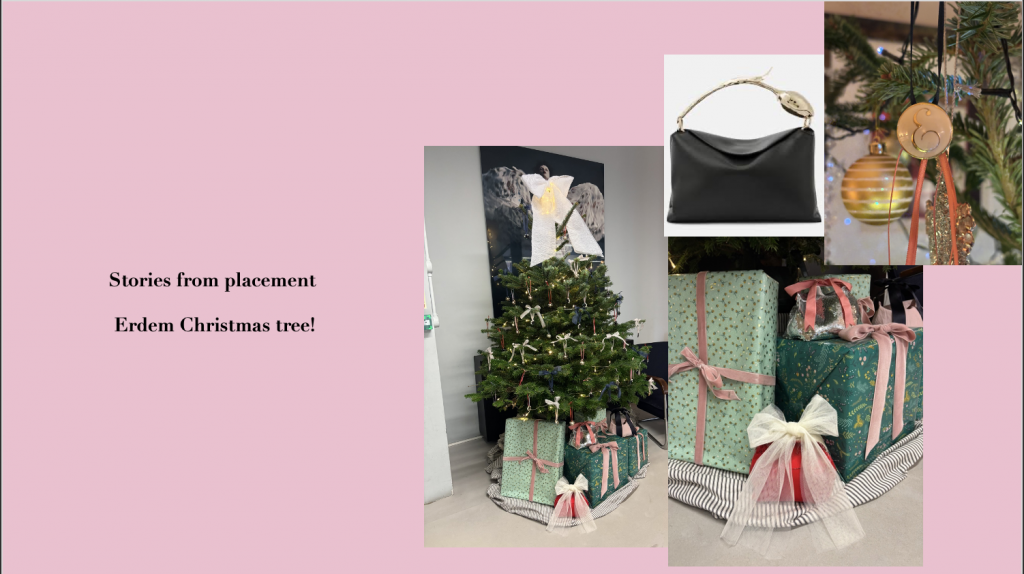
On my first day at Erdem, I immediately sensed that the experience would be transformative both personally and professionally. Reflecting on this now, I recognise that this feeling was connected to the vulnerability of entering a prestigious creative environment as a first-time intern. Despite excitement, I also experienced a strong sense of intimidation and self-consciousness, which aligns with research surrounding the “impostor phenomenon” (S Feenstra et al 2025) among early-career professionals, where individuals experience self-doubt despite their achievements. Over time, I realised that I never experienced this same intensity of feeling in later interviews or professional environments, which suggests that my confidence and sense of professional identity had significantly developed throughout the year. Similarly, I believe these experiences highlight the vulnerability of being at the beginning of a creative career, and how strongly early professional environments can shape and someone’s sense of identity and ambition. For example, my line manager had also started at ERDEM as an intern, working across multiple departments before eventually returning to the company as a full-time employee after graduation. Observing her loyalty and emotional connection to the brand made me aware of how influential prestigious fashion environments can become to someone, particularly for young creatives seeking belonging and validation within the industry. I recognised a similar attachment developing within myself throughout the placement.
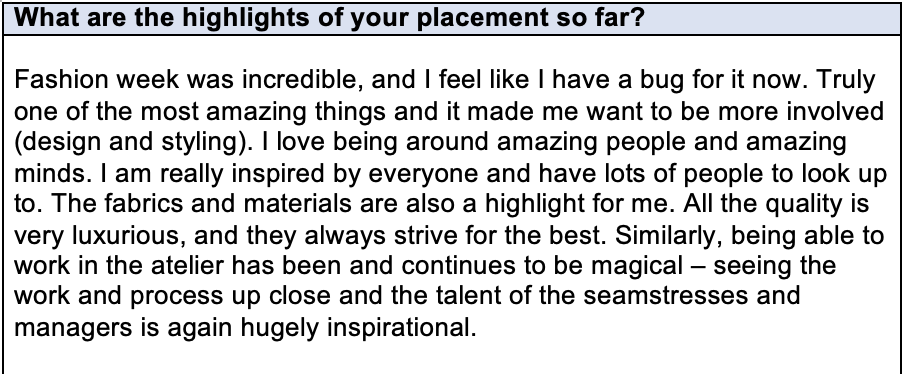
Being surrounded by the visibility and cultural prestige associated with a brand such as ERDEM, showing at events like London Fashion Week, with figures including Anna Wintour, made the luxury fashion industry feel aspirational and exciting. Reflecting on this now, I realise I became increasingly drawn towards the world of brand identity, recognition, press and industry status. Although these elements are important to the commercial success and visibility of fashion brands, I now recognise that I became less intentional about exploring wider creative opportunities outside of this environment.
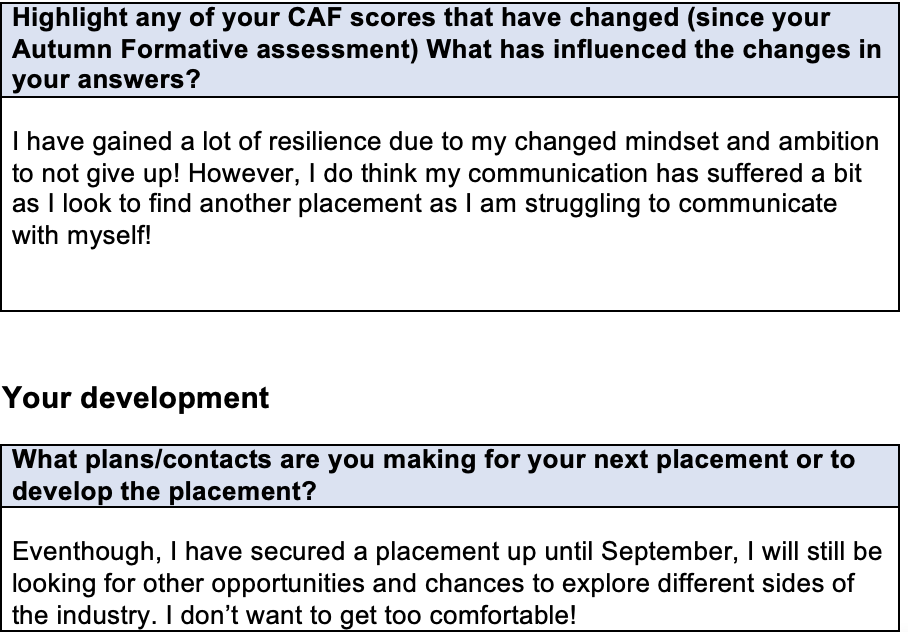
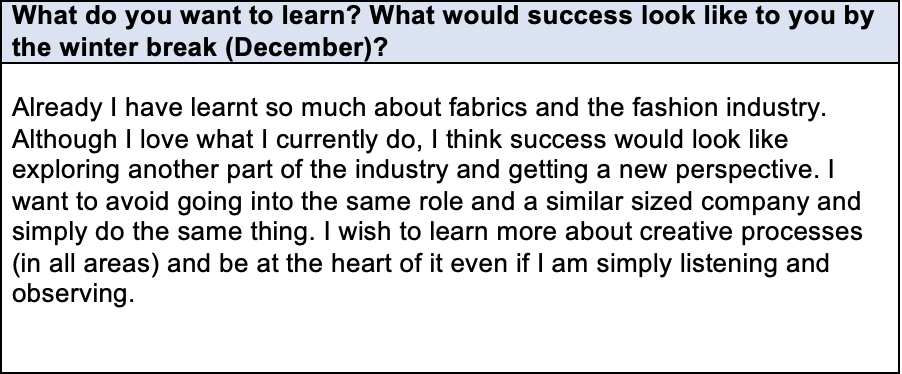
At the beginning of my placement year, one of my goals was to gain a broader understanding of the creative industries and explore the different contexts in which textile design could exist. While my experience significantly expanded my knowledge of London-based fashion brands and the structure of the luxury fashion industry, I now feel that I could have invested more time into researching placements that may have strengthened my creative storytelling abilities and personal design practice. In retrospect, this reflects how easily early-career creatives can become emotionally invested in prestigious environments, sometimes at the expense of exploring their wider creative identity.
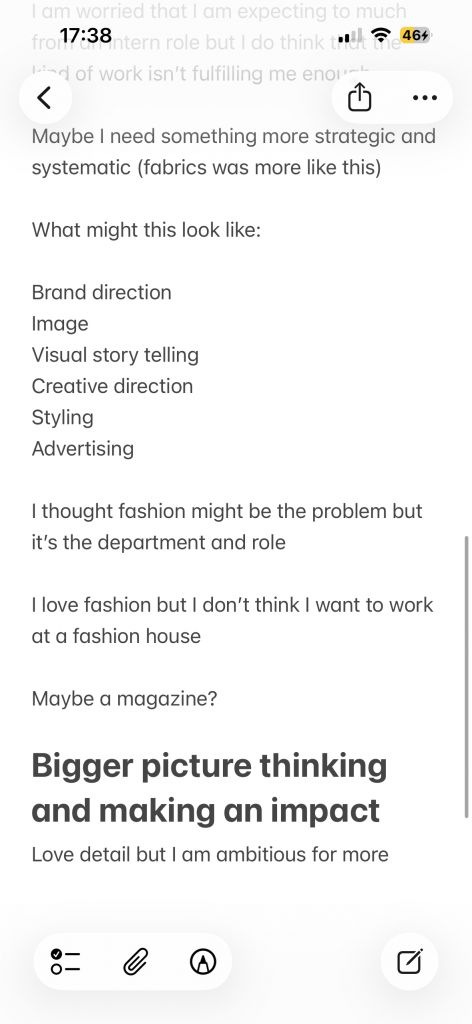
However, reflecting on this experience has also shown me the importance of reminding yourself of your personal creative passions outside of industry validation. I know that returning to my textile design degree will feel grounding, as it reconnects me with my personal and experimental approach to my practice, reminding me that creativity should not only be shaped by prestige or visibility, but also by individual expression, curiosity.
- Technical skills and developments and how this will aid my 3rd year work
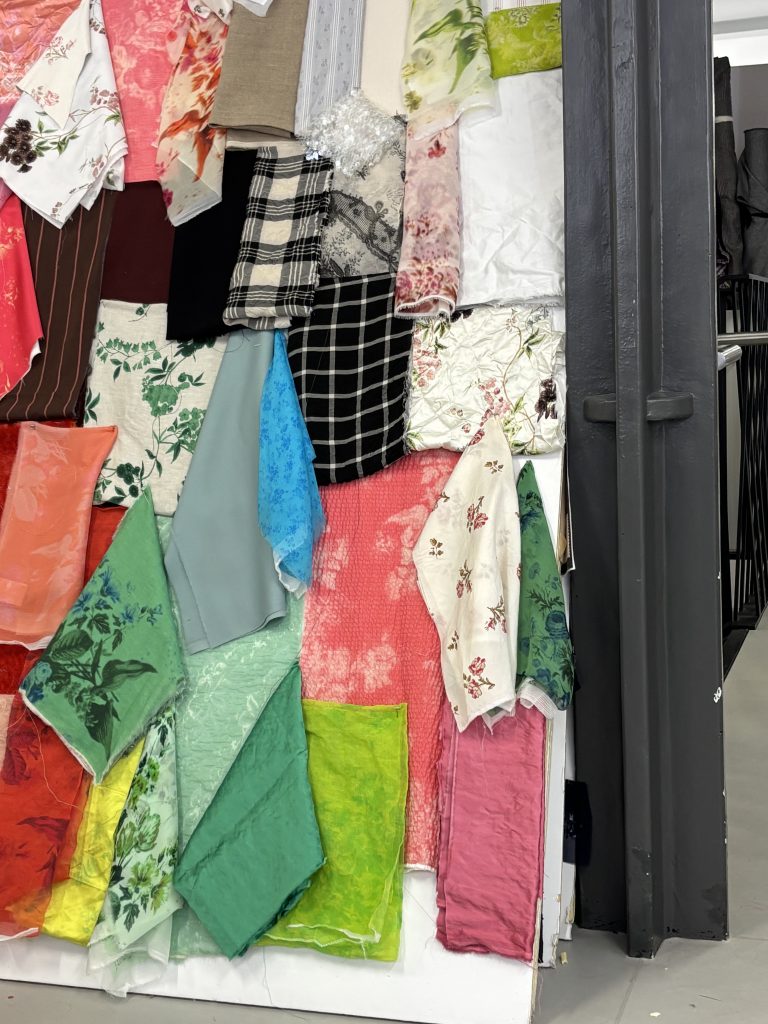
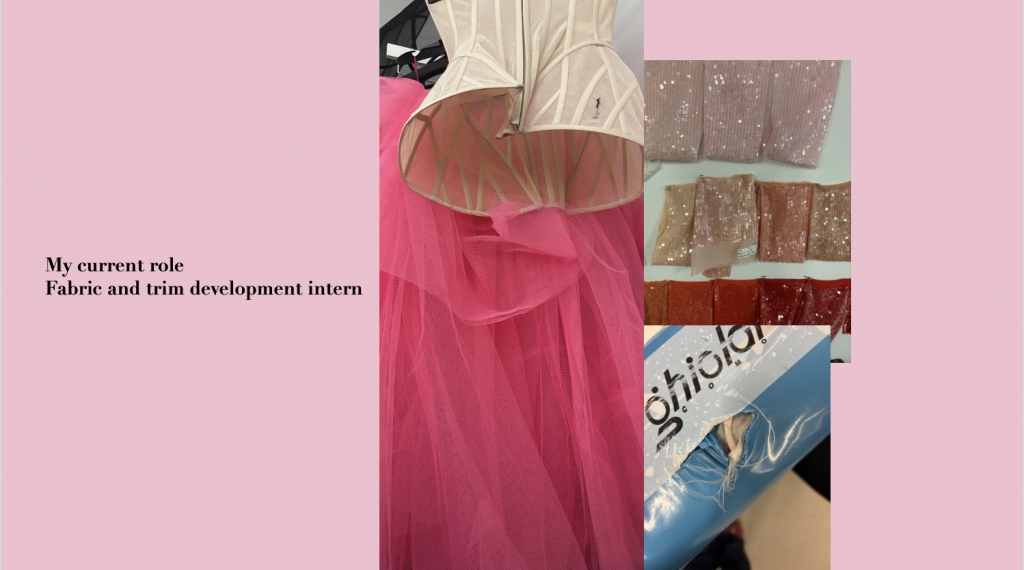
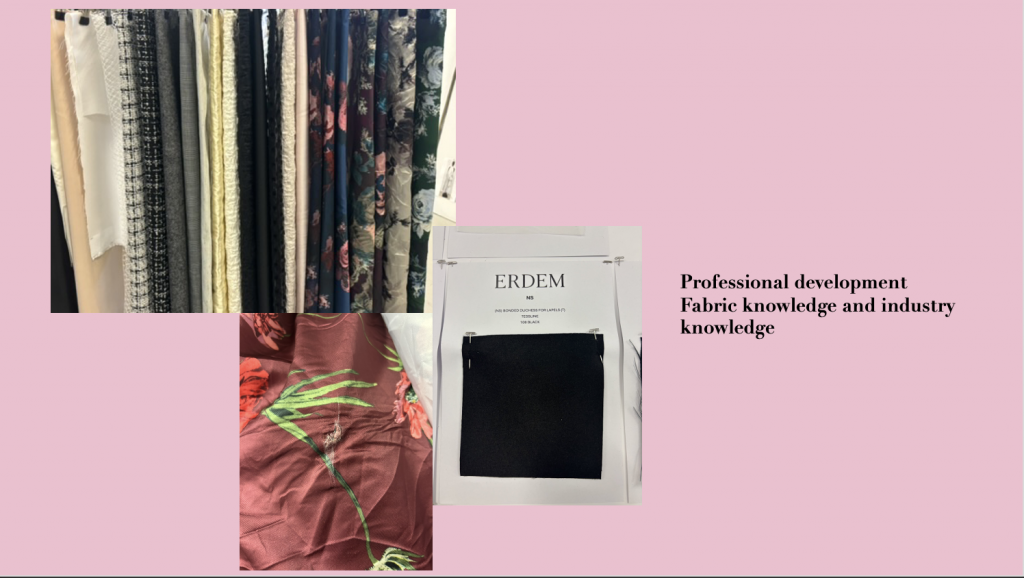
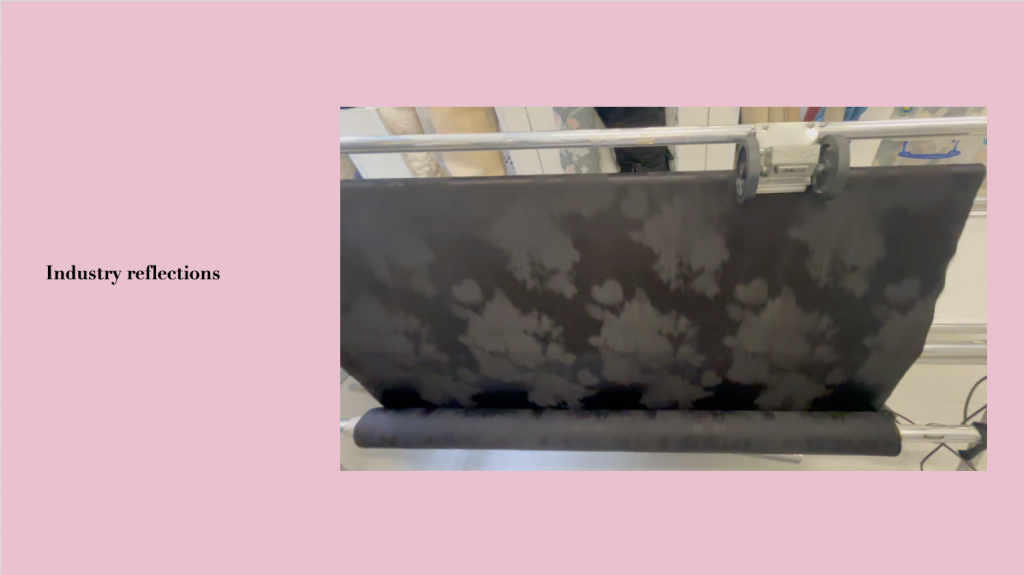
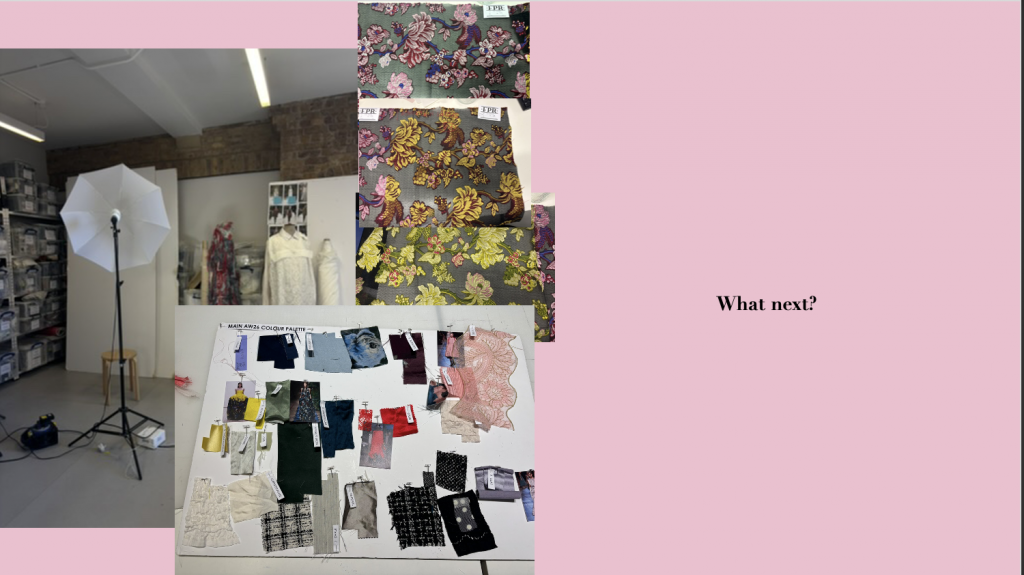
Whilst observing these concepts and structures, I was also learning the ins and outs of fabric development and how integral it is to the flow and timeline of building a collection. As a ‘stitch’ student, my main outlet of creativity is hand embroidery and fabric manipulation, whilst this is a big part of fashion, for fabric development, woven and printed textiles have more relevance.Printed textiles allow for streamlined creative experimentation as it is delt with in house by the print team. I noticed that the print department was very fast moving and adaptable. They have full creative control. However, woven fabrics are more outsourced. They rely on fabric technologies and innovation so, whilst technologies have hugely developed due to jacquard looms and yarn compositions, they require more development and communication. I noticed that the design team had to make more of a compromise with woven fabrics. Similarly to print, embroidery development is far more fluid due to technologies such as CAD and Adobe Suit. A skill I wish to develop in the future. The differences between these three departments interested me as they are working to the same goal but their approach and timelines where so different. These observations forced me to think about which department would be best suited to mm. I noticed I would, daily, weigh up the advantages and disadvantages of each department for a future career path and an angle to take for my final year. I am still not able to prioritise and instead, I wish to approach my final year with an interdisciplinary approach, which supports my foundations mixed media textile design. Going in, I had basic knowledge of each department, so I was able to see the context of textiles practises change from creative expression to a mix of; harnessing ambition from the design team to creative problem solving and eventually commercial production.
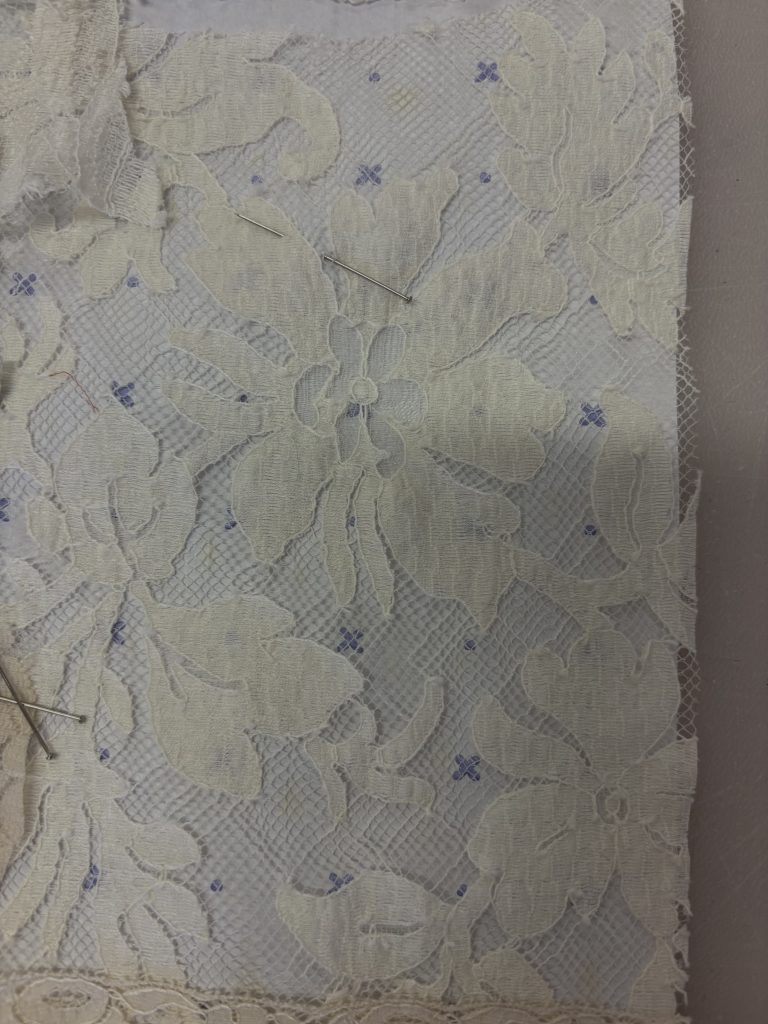
Within the first week I was able to understand types of weaves, e.g. jacquards, twills and fil coupes, to how a print artwork can be translated both in woven and print fabrics. On top of this, as fabrics is a part of product development and as I worked closely with the atelier. I saw what it takes to build a luxury garment. For example, types of bonding used for tailoring such as horsehairand lapel satin to achieve the classic look. The language used in the studio such as DMT (die to match), Lab dips (sending off a small fabric colour standard so mills can replicate it exactly in a fabric) and tirelles (French work for a fabric cutting, which in the studio is used by many as a reference to colour name, composition and fabric type) was a lot to take on however I was able to learn quickly as I was surrounded by it 5 days a week and had a true interest and passion for each purpose. I then noticed that once I understood the language used, I felt increasingly integrated into the workflow of the studio.
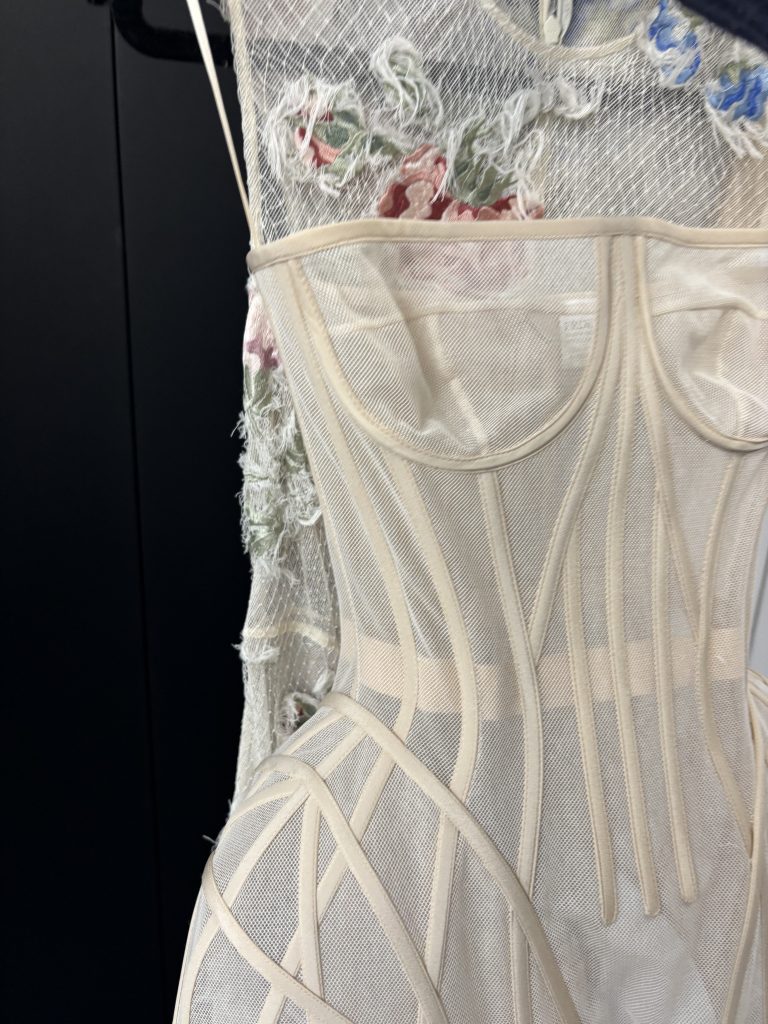
One thing that I noticed at once when starting was that technical execution enabled creativity, and only a small percentage of the collection development came from a promethean space. An abstract and ambitious collection cannot exist without technical precision. For example, being in the atelier changed my persective on luxury garments, as I began to understand the precision, material knowledge and hidden process that came from all parts of the studio to be able to reach a final product. I observed that craft, expertise and excellence were more necessary than creative ambition and concept.
Interestingly, this feels the opposite to what is expected of us at university so I believe that what I have learnt as a fabrics intern will directly impact my technical work in a very positive way. This then allowed me to adapt my approach and in turn taught me that hard work, communication and attention to detail aided me in navigating the environment feeling less out of my depth. This is something I resonated with highly due to my positionality. My family is naturally entrepreneurial, so I was encouraged to see discipline and consistency as ways of self-development and independence. These values were reinforced through my parents’ strong emphasis on independence and discipline; they pushed me both academically and in pursuing part time work. As a result, I was able to approach a large company environment with a sense of adaptability and responsibility which helped me feel less out of my depth in a professional environment and manage time pressures.
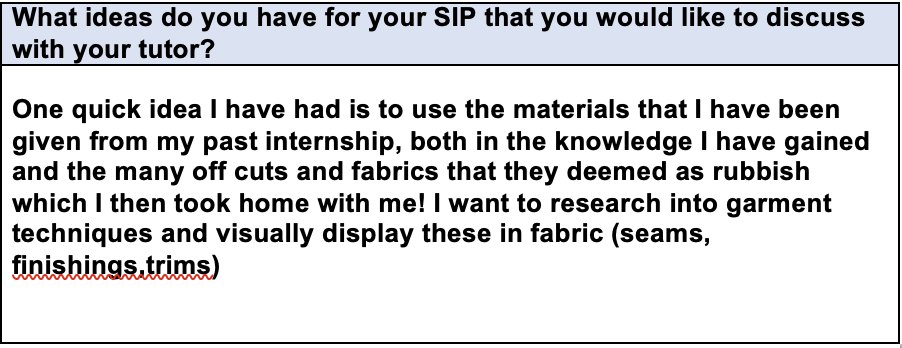
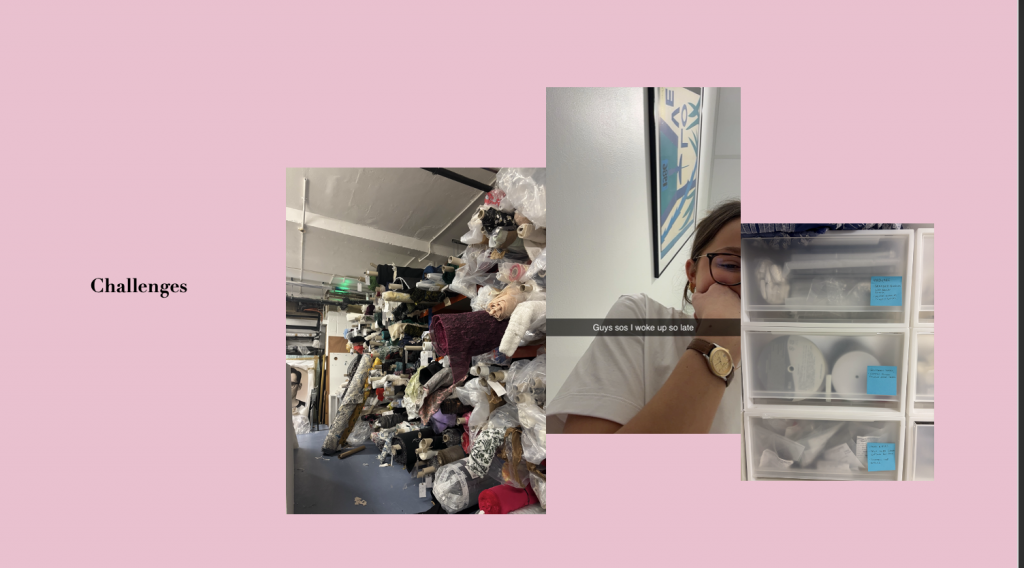
From a wider industry perspective, I have taken two main points from the fabric development world. The major one being how fabrics play a part in environmental challenges and developing more sustainable practices within fashion. Fabrics, I believe, are at the forefront of climate issues surrounding the fashion industry, from the way they are used and treated, to what is being chosen to be used. I learnt that companies would aim to work with mills that use organic cotton for denim and poplins as well as sustainably sourced viscose fibres. However, this does not under cut the waste issue that I observed at ERDEM. Specifically in the fabric department, twice a year there is a clear out of which they throw away any fabric hangers, trim samples (buttons, cords, clasps) that they no longer consider useful. This is done simply to make more room for another round of the above items. However, this did mean that the interns where able to look through what was being thrown away and take what they wished for their final year. I remember feeling surprised that they were willing to give this away and was expressing my thanks. I can now recognise that this reaction stems from my naive and idealistic perspective, whereases this process had become normalised. It seemed that they had done what they can by sharing the resources, but they had other pressures that needed more attention, such as exploring and sourcing well priced GOTs cotton (Global Organic Textile Standard). Unfortunately, although I was surprised to see such beautiful things go to waste, the level of waste was not completely unsurprising. This was due to the amount of collections they do a year, which is a minimum 6 not counting collaborations and bespoke projects. I began to understand that the pressure to continuously produce new seasonal collections inevitably encourages constant material and creative renewal.
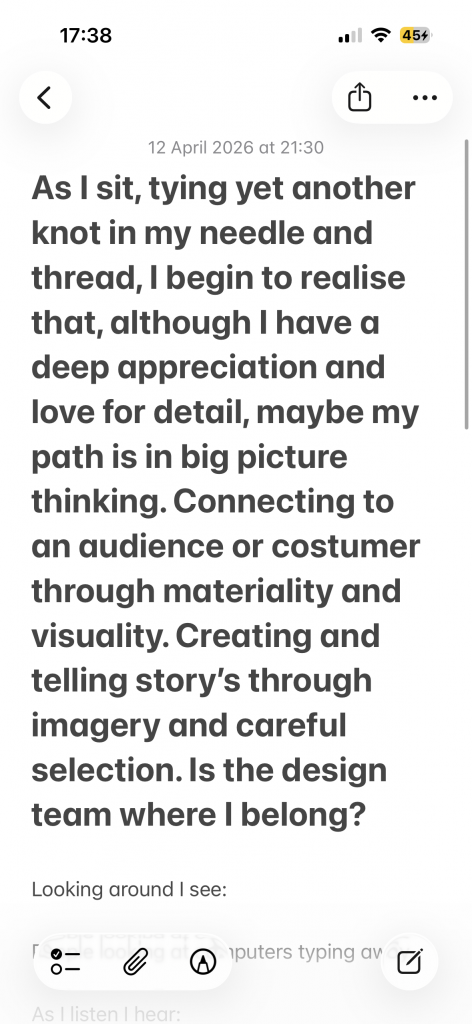
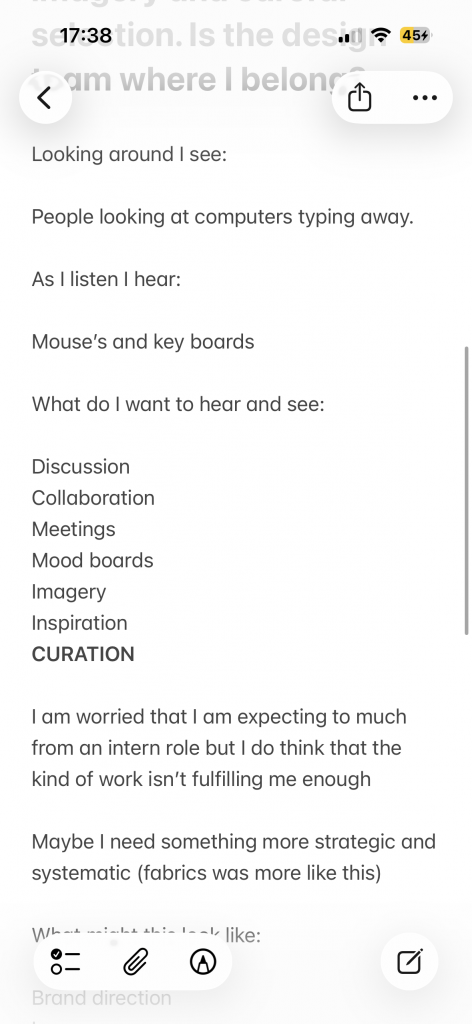
The second industry observation made is the career development of a fabric developer. Most fabrics team will come under the umbrella department of Product Development rather than beingits own department or what I expected to be a part of the design department. So, the ‘Head of Product Development’ governs the fabric team. What I slowly became to realise was that this limits a fabric developers’ ability to reach Upper Mid and Highest-level job rankings such as ‘Head of [Department]’ or ‘Director’. A clear and strong career development I realised was something particularly important to me which became known when I did a trial week at Simone Rocha under their textiles and fabric department. The business structure at this company differs to that of other London companies. There is a consensus that very few people in the fashion industry have an insight into the company and that it ‘keeps to itself’. Working there for just 3 days, I learnt to understand why this was the case. Most departments consisted of 1-2 people, many of those having worked there for 5+ years. My line manager while I was there had been working there for 12 years, going from a student intern, straight to a full-time employee after graduation. This speaks to two ideas, one being that there is less visibility into the brand due to limited employee turnover therefore less discussion on the brand and their experience, the second being how successful fashion brands have an impact on early creative careers, leading to a strong sense of loyalty to the first brand they experienced.
Once I had identified this pattern, I began to research career developments of my coworkers and other similar people via LinkedIn. I found that those such as ‘Head of Product Development’,who I observed to have a close relationship with the Creative Director, usually have between 10-15 years’ experience before hand in Product Development, spanning over 3+ luxury brand names. Similarly with Design Directors, again with a close relationship to the Creative Director, will have 10+ experience in design. From knitwear designers to head of flou. The thing that limits fabrics from achieving the same as a designer or a product developer is the focus on design on the body and garment
Fabrics ‘glass ceiling’
Chapter 2: Finding another placement
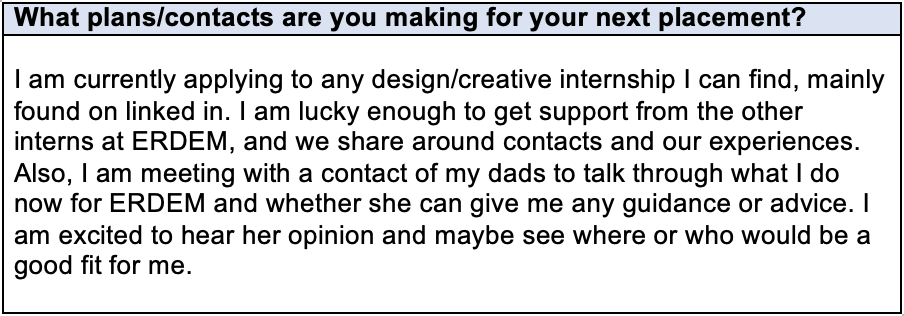
Around halfway into my time at Erdem, I began to worry about what my next step would be. As you connect with people in the company you learn what their backgrounds are and what companies they have been at before. The Erdem employees have a strong portfolio of companies, most of them working at all the major brands in London. After realising this, I wanted to use my connections to my advantage and ask if anyone knew any intern positions coming up. So, I approached someone I felt most comfortable asking, interestingly this was not anyone in my department as I felt that this would appear overly dependent. This person connected me with a few friends she had as well as the Press Team at Erdem. Regrettably, I feel I was complacent in how I dealt with the contacts. The roles did not interest me as they were technical roles such as pattern cutting. Although I communicated that any opportunity would be appreciated, I found it interesting that I still had boundaries and preferences of what job I was willing to do, even though it is in the industry I am passionate about. I think this also speaks to expectations and reality of working in fashion and how it is not as simple as simply working for a fashion company. For example, the logistics team, although had the context of fashion, will not feel the sense of glamour and excitement you can feel working in fashion. But these parts of the industry would not be possible without teams such as logistics and production.
Whilst I cannot do anything now to make up for this, my contact was very happy for me when I got my next placement. Overall, the hardest part for me was beginning the discussion in the first place and I learnt that the conversation itself is the most beneficial to growing your network. I do, however, remember feeling emotions of selfishness and guilt from asking as I felt I couldn’tgive anything in return. Although this didn’t result in a placement opportunity, on reflection I am glad I pushed myself out of my comfort zone.
During the search for my next placement, I was more successful when using contacts given to me by my peers. Another intern I worked with at ERDEM was kind enough to give me the email to the design director at Simone Rocha. Soon after I interviewed with them and was invited to a trial week. This experience in comparison to other applications I found through LinkedIn and the UAL Creative Opportunities site was far more positive. I did not get any sort of contact from the 12 other companies I applied to. I also believe that this is possibly what stunted me in being able to explore other avenues of creative careers as my network was limited to who I was working with at the time.